
Completing an apprenticeship is a major milestone reflecting real-world skills, industry standards and a nationally recognised qualification. Once complete, an official certificate is issued — presented in person by a training advisor or couriered to the workplace. It represents personal commitment and hard work, plus the support of the workplace, whānau and others along the way.

All apprentices have access to mental health and wellbeing resources. Competenz offers free confidential counselling through our provider Vitae, with the learner's choice of counsellor. A 24/7 contact centre and duty counsellor are available for emergencies.
About making confident money decisions. Competenz connects apprentices with trusted tools and resources from the Commission for Financial Capability to build confidence managing money.
Sometimes reading, writing or maths can get in the way of progress. Competenz partners with expert tutors. Support includes:
Signs someone may need help: avoiding responsibility, repeating the same errors, hesitating to ask questions. Contact your training advisor or email learnersupport@competenz.org.nz.
At the start, apprentices complete a short literacy and numeracy assessment (online or paper) to identify strengths and areas where extra support could help.
Dyslexia doesn't affect intelligence but can make reading, writing and working with symbols harder. Competenz offers a free online 'QuickScreen' screening tool; we manage the application with Workbridge and help arrange resources.
Everyone learns differently, and apprentices aren't expected to know everything from day one; what matters is knowing where to go for help. One of the most important supports is the training advisor, who visits regularly to:
Between visits, apprentices can contact their training advisor by phone or email any time.
If an apprenticeship includes online learning and your apprentice doesn't have access to a computer, Competenz can lend them a Chromebook. Talk to your training advisor to arrange one.
If an apprentice needs help with eLearning or is stuck on a question, call 0800 526 1800 (and press 4) on Tuesdays, Wednesdays and Thursdays between 5pm and 8pm to talk to one of our eAssessors.
Available to support learning and connect apprentices with others on a similar journey. Usually held fortnightly during the week, running for two hours, led by experienced experts who help with assessment questions and study tips. Once enrolled, regular attendance is expected unless unwell or given leave by a manager due to work demand. Enrolment and session details through your training advisor.
Where textbooks are part of a programme, they're provided to support theory and practical learning. Textbooks for an apprenticeship are listed in the apprenticeship details and training plan.
Encourage apprentices to bring on-the-job assessments into team spaces like the staffroom. Talking through tasks in a relaxed setting helps them learn and lets qualified tradespeople share skills and experience, benefiting the wider team through knowledge-sharing and fresh thinking.
Learning by doing means we don't always get it right first time; that's part of the process. Apprentices may revisit work, apply feedback and try again. Employers play a big role by encouraging and supporting apprentices as they build confidence. Assessments are only complete once everything is correct — all questions answered and all practical tasks marked competent.
The assessor explains which questions weren't answered correctly, gives guidance on what to improve and where to find help. Read all feedback carefully and focus only on the questions identified. Only those questions/sections need updating and resubmitting — no need to resend the entire assessment.
Apprentices submit completed assessments, with required evidence and signatures, by email or directly to their training advisor. For eLearning assessments, they submit directly through the platform. All assessments must be the apprentice's own work — being honest about what's been done and who helped builds trust and makes the qualification mean something. Copied or AI answers take away from real learning and could delay progress.
If the apprenticeship includes eLearning, apprentices complete open-book online assessments. Most answers are in the learning materials, though some questions need extra research. Two types:
To avoid delays, before starting an eAssessment apprentices should:
If an assessment includes both types, the machine-marked results show first.
For some assessments, apprentices provide photos as supporting evidence. Read the requirements carefully for exactly what's expected. Be disciplined from day one — if storing photos on a phone, download and back them up regularly. Apprentices and employers should regularly review the saved photos together to keep on-the-job learning on track. The apprentice learner guide provides best-practice guidance.
Every assessment guide includes clear instructions on:
Read it carefully and follow the instructions — incomplete submissions cause delays. If the apprenticeship includes eLearning, all assessment guides are available through the eLearning platform. The training advisor works with the apprentice to agree which unit standards to focus on and when assessments should be completed. On-the-job assessments are downloaded, printed and completed by the apprentice, then observed and verified by their workplace supervisor, then submitted to a Competenz assessor (usually the training advisor) for marking and feedback.
How we check what apprentices have learned and can do. Some are like quizzes (written or online questions); others ask for a practical task to be verified or observed by someone qualified; sometimes a mix. Every assessment comes with a guide explaining what needs to be done. Once submitted, a trained assessor reviews it, checks it meets requirements and gives clear feedback. The apprentice works through the feedback until they've met all requirements — written and practical.
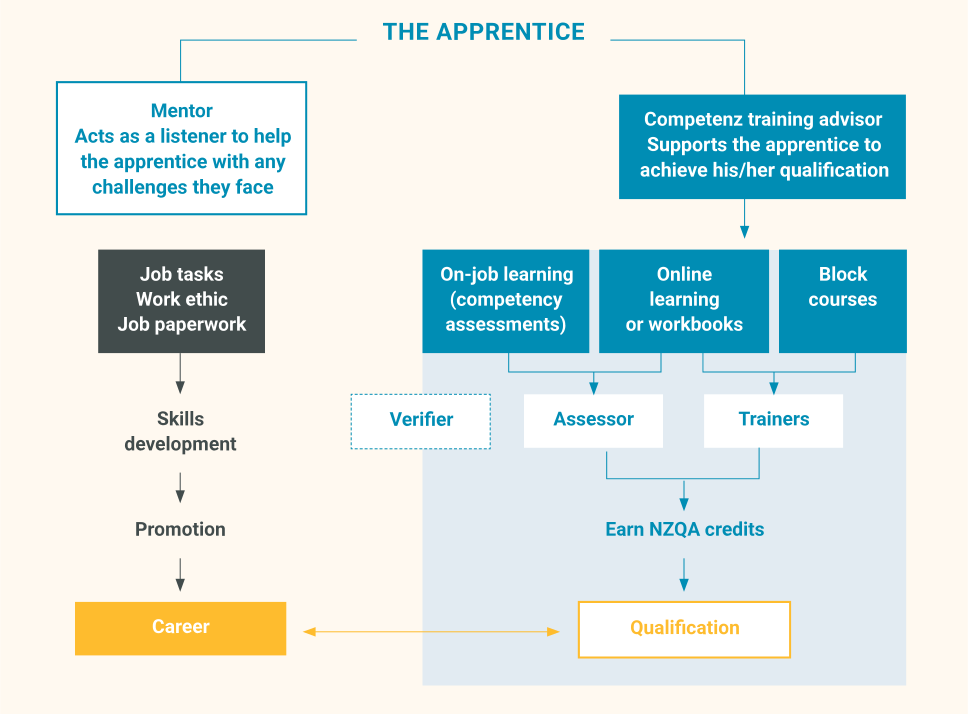
Assessment is a team effort:
Usually supervisors or team leaders in the workplace. They watch the apprentice perform a task and confirm it was done to the right standard. They don't make the final call; they sign off that the apprentice is ready to be assessed.
Trained professionals who review the apprentice's work (written answers, reports or practical evidence) and decide if it meets the standard. They make sure assessments are fair, consistent and meet national requirements. In most cases your training advisor is also your assessor.
Mark assessments completed through the eLearning platform, checking work against the unit standard and deciding 'competent' or 'not yet competent', with feedback and guidance.
Based in the workplace, trained and approved by Competenz. They can both verify and assess on site. Not every workplace has one; if not, the training advisor arranges someone else.
Competenz training advisors make regular in-person visits to check in and review progress. We strongly encourage both apprentice and employer to attend together. After each visit, the training advisor provides a visit summary report outlining:
Go over the report together — celebrate progress, spot anything that needs attention, reset goals if needed. Between visits, check progress online by logging in to Competenz Central and opening eServices. If you don't have access, your training advisor can set it up.
Success doesn't happen by accident; it takes planning and teamwork. Apprentices need to commit to regular weekly study time. Employers play a key role by providing support and staying in regular contact. If your workplace has a quiet room, consider making it available for study — before or after work, or during work time if you're open to it. Just one dedicated study session each week can make a big difference.
Every apprenticeship has its own set of unit standards and credit requirements; the training plan lays out what needs to be completed and when. Your training advisor will help create a realistic study plan.
For apprenticeships that include eLearning, apprentices receive an initial email with login instructions. They're also invited to an online induction covering how to use the system and how eAssessments work. Once a unit is achieved, it is archived — still there when needed, but out of the way of outstanding units. There is a 'getting started with Canvas' course available. All assessments are accessed through the eLearning platform. For questions about using eLearning, contact your training advisor first; if unavailable, email canvas.lms@competenz.org.nz.
Depending on the qualification, your apprentice may be required to attend block courses. Before they can attend a block course, they must complete all required pre-requisites.
The individual training plan outlines the structure for the apprenticeship. It is put together by the apprentice, Competenz training advisor and you, the employer. It includes a variety of learning resources and assessment methods. The training plan is divided into a series of steps, made of a group of unit standards, each with an assessment that the apprentice must pass.
The order in which the apprentice does their learning is important — they need to learn the right things at the right time. For example, we want to ensure the apprentice has the relevant Health and Safety knowledge before applying it in the practical on-the-job units, and that they understand the basics well before attempting more advanced assessments. Your training advisor will help order the plan to suit your workplace and the apprentice's needs. From there, it's about sticking to the plan and making steady progress.
A training agreement is the official document that sets up an apprenticeship. It is signed by the employer, the apprentice (also called the learner) and Competenz. This agreement:
It also gives Competenz permission to access and share relevant information about the employer and the apprentice, so we can support the training properly and meet national reporting requirements. Signing the agreement means everyone understands their role in helping the apprentice build skills and succeed in the workplace.
Apprentices learn in three main ways:
Most training takes place in the workplace. The employer or manager demonstrates how tasks are done and checks that the apprentice has learned the skill. Apprentices develop their abilities by doing real work as part of their daily responsibilities, gaining hands-on experience and applying what they've learned in practice.
Some apprenticeships include an online learning component, completed through the eLearning platform. This theory-based content supports the practical skills being developed and helps build foundational knowledge.
Some apprenticeships include block courses, usually held at a polytechnic or training provider. These run for 2 to 3 weeks and give apprentices a chance to focus on specific skills, often with access to specialist equipment, practical projects, and experienced tutors away from the day-to-day workplace.
Together, these three learning methods prepare apprentices to meet the national industry standards for their trade or chosen strand.
For feedback on your training materials (evidence guides, learner guides, assessments) email: resource.help@competenz.org.nz
You can expect to be asked to take part in confidential Competenz surveys during your enrolment, as well as 6-12 months after you have graduated. Some of those surveys are required by NZQA. Others are for feedback and improvement purposes.
Got a concern or complaint?
If something's not working, talk to your training advisor first — most issues can be sorted quickly this way.
If you'd rather speak to someone else, you can call us on 0800 526 1800 or fill out a complaints form on our website.
We treat all complaints with respect, confidentiality, and fairness. You'll get a written response, and we aim to resolve formal complaints within 10 working days.
Every apprentice brings something new to our industries — and by learning new skills, you're creating new possibilities for yourself and the people around you.
Thousands of learners have taken this path and gone on to build great careers. With focus, support and effort, you can do the same.
We're excited to see where this journey takes you.
We're committed to protecting your privacy and managing your information responsibly.
Competenz is required by law to collect and store personal information from your signed training agreement. This is done in line with the Privacy Act 2020 and the Education Act 2020.
The information we collect helps us manage your enrolment, report progress, and meet legal and industry requirements.
The personal information collected on the training agreement is disclosed to government agencies and may be disclosed to outside organisations as follows:
Competenz securely stores your personal data for 10 years in the learner management system. This will include your programme enrolment, records and assessment results. All completed assessment work is held for moderation purposes for 12 months after the end of the qualification. The assessment material may be stored longer if it is involved in an appeal or disciplinary procedure and stored for 7 years if it is used for moderation.
You can withdraw from your programme if your personal circumstances change. Please talk to your training advisor about your reasons for withdrawing. We consider this a last resort. There may be a way we can help you continue by adding extra support, or we can put your training on hold for a while.
Your training advisor may recommend that you transfer from one programme to another. Fees may be transferred for approved programme transfers.
Competenz charges their fees pro-rata and a credit will be issued to the party paying for the fees if you withdraw partway through a year.
Finishing your qualification is a major achievement. It shows you've committed to learning, built new skills and reached the recognised standard in your trade.

When you complete your programme, you'll be awarded a formal certificate of achievement. This qualification is a clear sign that you're ready for more responsibility, greater opportunities and the next step in your career.
Your training advisor will either present your certificate in person or have it couriered to your workplace. You're right to feel proud because this is a reminder of everything you've achieved and the future you've prepared for.
As an apprentice, you're expected to take responsibility for your own learning and conduct. That means doing your own work, acting professionally and meeting the standards set for your training.
These responsibilities help ensure your qualification is earned honestly and fairly — and that you're ready for the expectations of the job.
Being honest means your assessment must be your own work and not copied from a book, website, study guide or from another learner's work. This includes helping another learner complete their assessment, sharing what you wrote, telling someone else the answer, or assisting another learner to complete a practical task that they should be doing on their own.
Use of generative artificial intelligence — your assessments must be your own work and not written by another person or generated using artificial intelligence (AI). Competenz may use AI detection software to check your work is genuine.
Conduct — participating in training requires acceptable conduct. Discrimination, bullying, harassment of others, or being under the influence of drugs or alcohol can result in your being removed from training.
Health and safety — our training programmes are designed to reflect industry best practice and comply with the Health and Safety at Work Act (2015). Your employer is required to have adequate health and safety procedures and policies in place in the workplace, and to tell you about them.

No one completes an apprenticeship alone. Support can come from your supervisor, your whānau, your training advisor, and your peers. But staying on track starts with speaking up and asking for help when you need it.
If something's unclear — whether it's about your training, assessments, or how to manage your time — don't sit with it. Talk to your training advisor or someone you trust at work. They're there to help you succeed, but it's up to you to reach out.
Study groups are held online every two weeks and are open to all apprentices.
They are run by experienced subject experts and are a great place to:
You can take along any questions or areas you're stuck on. To find a study group that suits your programme, talk to your training advisor about how to enrol.
Every step you take in your apprenticeship helps you get closer to your qualification. To get there, you need to keep making steady progress at work and in your learning.
You can read more about how your progress is tracked in the Structure of an Apprenticeship booklet. It explains how assessments work, what counts as progress and what you and your employer need to do to keep things moving.
When you get your learning material and assessment tasks, take some time to plan ahead. Use a calendar or planner to create a simple weekly routine. This will help you avoid cramming at the last minute or feeling overwhelmed and stressed later on.
Try this:
Most apprentices are expected to finish at least one or two units each month. If you fall behind, don't wait. Get in touch with your training advisor.
Your programme is designed to build your skills one step at a time. If you stop making progress, it can knock your confidence and slow down your journey.
Things don't always go to plan. That's okay. What matters most is that you stay involved, ask for help when you need it and keep aiming for your goal: a recognised qualification and the confidence to take on more responsibility in your trade.
Your record of achievement is a summary of all the unit standards and qualifications you've completed. Each time you pass an assessment and earn credits, it gets added to your record.
You'll find a detailed breakdown of how assessments work in the Structure of an Apprenticeship booklet. Access to and knowledge of the New Zealand Standards may be needed to complete the assessments. This will be detailed in your training plan.
This section gives you a quick overview and helps you see why doing well in assessments really matters.
Assessments aren't just about ticking boxes. They're your chance to prove what you've learned, show how far you've come and move one step closer to your qualification. Staying focused and putting in the effort now will pay off in the long run — not just with a certificate, but with confidence, skill and job readiness.
Some parts of your learning may be assessed online through the eLearning platform. Competenz has a team of eAssessors who review this work. If you're unsure about a question or stuck on a task, don't sit in silence — help is available. You can reach the eAssessors through the Competenz support hub.
Most of your assessment happens on-the-job — showing that you can do the tasks needed in real work situations. A Competenz assessor (or a qualified workplace assessor) will guide this process and make the final call on whether you've met the required standard.
You'll need to work with your verifier to help plan:
Some units will ask for both practical demonstrations and supporting evidence. Keep records, take photos if needed and talk to your verifier about what's expected. The more prepared you are, the smoother your assessments will go.
For many unit standards, you'll need to provide evidence that shows you've completed a task or developed a skill to the required level. Providing clear, easily verified evidence makes your assessment easier and helps your assessor see that you're ready to move on.
You can appeal an overall assessment competency decision if you believe it was not accurate. You must first talk to your assessor about the matter. If you wish to take it further after that conversation, you can ask Competenz to investigate by email QA@competenz.org.nz.
Before you start your formal training, you'll complete a short onboarding to help you settle in, get confident and learn how everything works.
Our onboarding process gives you the knowledge and skills you need to feel confident in your role and succeed in your learning.
We'll guide you through the key steps, so you know how to manage your learning, stay on track and find support when you need it.
What's included:
Your training advisor is here to support you throughout your apprenticeship. They'll work closely with your supervisor to help you build the skills you need, and check in regularly to keep your training progressing smoothly.

They're also here to figure out what support might help you succeed — whether that's a new plan, extra resources or simply answering your questions. Your advisor is backed by an awesome team at Competenz, and they really enjoy helping apprentices move forward.
They'll visit you in-person regularly throughout the year.
During each visit, they will:
You'll also get a schedule of upcoming visits. And you can contact your advisor any time by phone or email if you need help between visits.
Your Competenz training advisor is your support person and may also act as your on-the-job assessor. An eAssessor will assess any online learning that may be part of your apprenticeship. All assessors are trained for their role and continue to develop their skills through professional development.
Most of your training will happen on-the-job under the guidance of your supervisor or a qualified tradesperson. You'll learn by watching, asking questions and then doing the task yourself. Your trainer will show you how to perform the skill, supervise you as you practise, and support you until you get it right.
It's a great way to learn — so stay curious, pay attention and apply yourself. When your trainer sees that you're confident and capable, they'll let your assessor know that you're ready to be assessed.
Your trainer also acts as your verifier. This means they observe your work and confirm when you're ready. They don't make the final assessment decision — that's up to your Competenz assessor.
Before your training gets underway, there are a few key conditions you need to meet to stay eligible and on track.
To continue to learn through on-the-job training with Competenz, you must stay employed in the industry you're training in.
It's important to keep your workplace and personal contact details up to date. Let your training advisor know of any changes or call 0800 526 1800 to update your information.
If you're working in New Zealand on a work visa, your visa must be valid for the entire length of your training programme. If your visa expires before your programme ends, Competenz cannot report your results to NZQA or issue your qualification.
Your training advisor will check that your visa meets this requirement when you sign your training agreement. Competenz will continue to monitor its validity while you're in training.
If you discover your visa is due to expire during your programme, talk to your employer and training advisor early so you can plan ahead and avoid any disruptions.
If you've already gained skills or knowledge from work or past study, you may be able to have that learning formally recognised. This could mean you don't need to complete some parts of your training again.
The RPL process is not funded and is offered as a user-pays service. To find out more, search for "Recognition of prior learning" on our website.
Every workplace is different. Some are big with lots of people. Others are smaller and set up differently. No matter where you work, your training is designed to fit around real work and real learning.
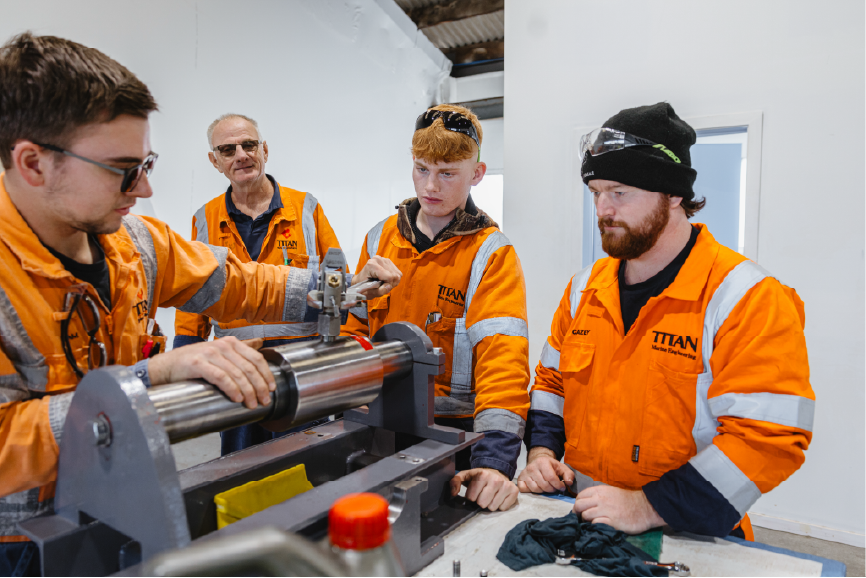
You'll be learning through a blend of on-the-job experience, online learning and regular support. This is called a blended learning model — it helps you build skills step by step, while getting stuck into real work from day one.
Some programmes also include an off-job component, like block courses held at a campus or training provider. These give you the chance to focus on practical skills in a different setting, often using specialised equipment or learning from subject-matter experts.
Two key people will support you throughout your journey:
Your training plan brings everything together. It shows what you'll be learning, when to complete assessments, and how each part links to your qualification.
Apprenticeships are about learning by doing. You'll build new skills on the job and grow more confident as you go. Every task, challenge and assessment helps you take another step forward.

Your programme is carefully designed to support that growth. You'll complete assessments in a set order, building from the basics toward more advanced skills. Following this sequence matters. It helps you learn the right things at the right time, especially when it comes to safety and practical tasks.
To stay on track, you'll need to make regular time for learning. This means completing unit standards, keeping up with your training plan and asking for help when you need it.
Throughout your apprenticeship, you'll be supported by your employer and training advisor — and we'll help you make the most of every opportunity to learn.
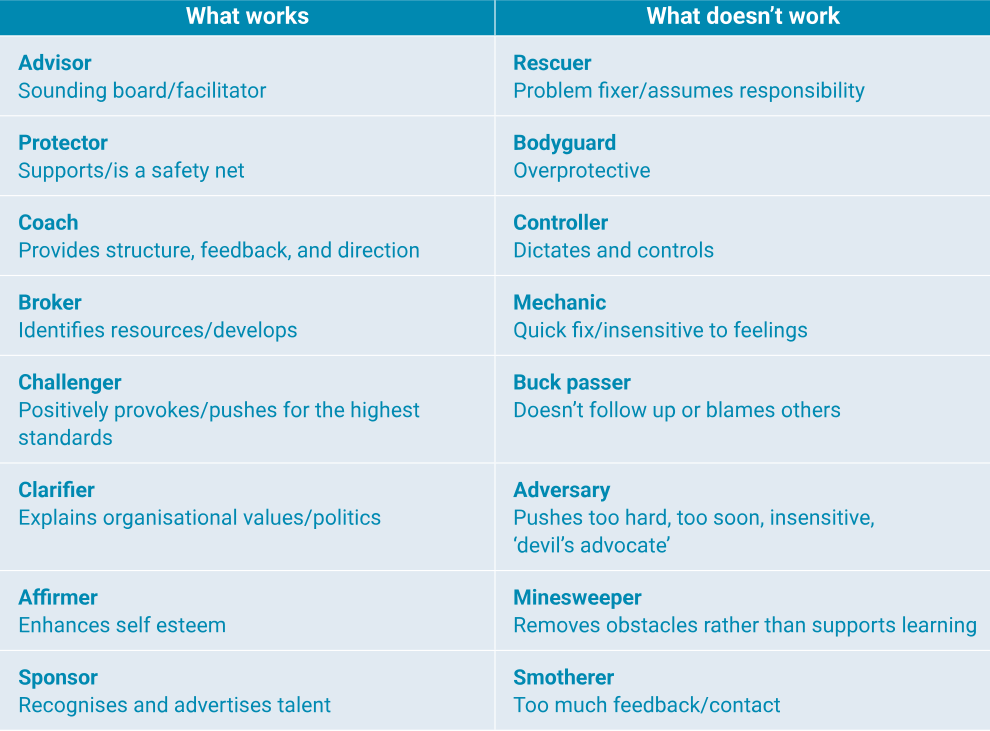
Competenz's code of ethics for apprentice mentoring relationships (adapted from Ako Aotearoa and the New Zealand Coaching and Mentoring Centre):
Support is available for learners who have literacy and numeracy challenges. Contact your training advisor, who can access specialist support.
Active listening means to listen fully and aim to understand what is being said. A good tip is to repeat what you think you're hearing to make sure you're on the right track.

GROW is a simple, practical framework that helps structure conversations. The four steps:
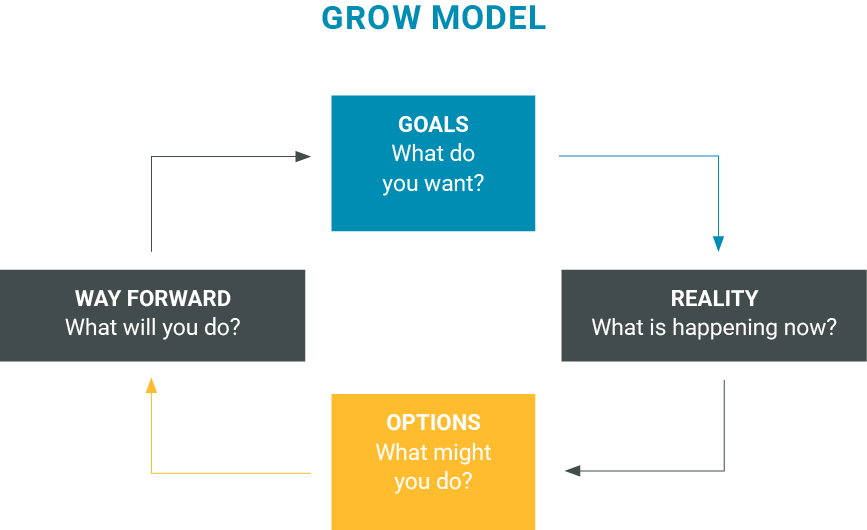
Set a clear, specific goal (short-term like completing a task, or long-term like gaining a new skill). Good goals are SMART: Specific, Measurable, Achievable, Relevant, Time-bound.
Explore the current situation: What's happening right now? What progress has been made? What's standing in the way? This separates fact from assumption.
Encourage a wide range of ideas, even those that seem out of reach. The aim is to open up thinking, not jump to a solution — this builds the apprentice's own problem-solving skills.
Decide the next step: what action, by when, and what support is needed. The apprentice should own the action — this builds motivation and accountability.
Always assume the person you're mentoring has the ability to find their own answers. Your role is to support, guide and unlock their potential — not to direct, fix or control the outcome.
Everyone learns and communicates differently. The VARK model identifies four common learning styles:
There's no right or wrong style — most people use a mix, but knowing what works best for your apprentice makes a big difference when planning training or giving feedback.

Mentoring helps all parties understand and bridge cultural differences. The Māori and Pasifika Trades Training Initiative (MPTT), which includes mentoring, has been hugely successful in creating great apprenticeship opportunities. Competenz also offers Pasifika study groups and learner support — contact your training advisor.
Any worker can mentor others, with real benefits to everyone involved.
Job satisfaction often comes from making a meaningful contribution. Mentoring lets senior staff pass on knowledge, stay engaged and feel valued; it retains hard-earned expertise and supports succession planning.
Mentoring helps experienced workers grow beyond technical roles, building communication, leadership and coaching skills and often reigniting a sense of purpose.
Mentoring builds confidence and reinforces learning, giving a sense of responsibility and developing empathy and communication. It helps if the mentor has been an apprentice themselves.
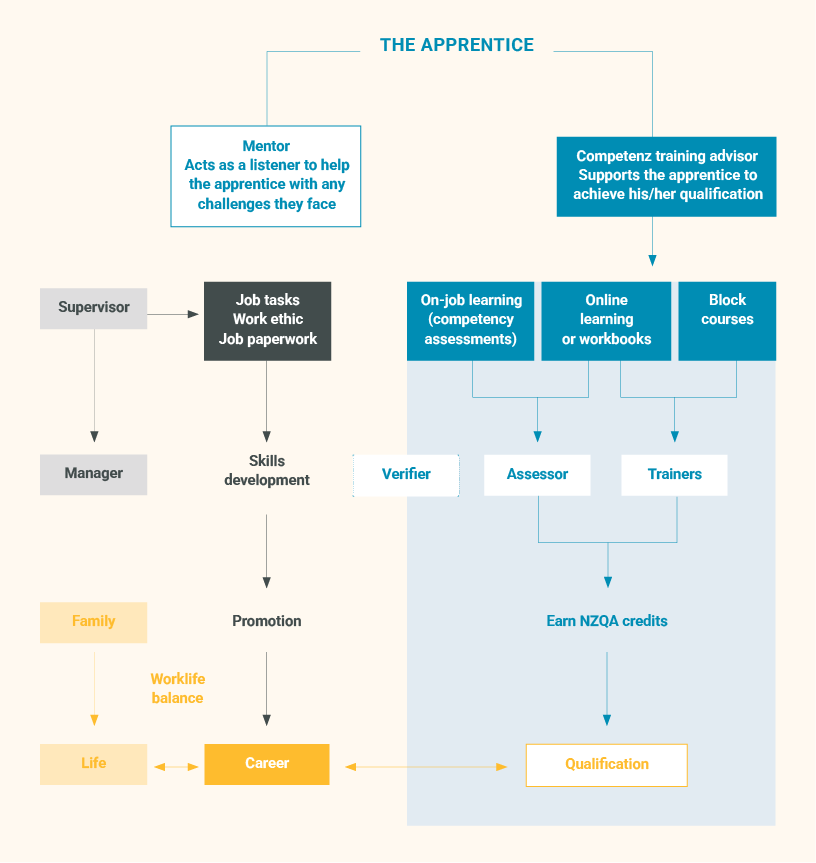
Mentoring strengthens every element of an apprenticeship, from skill development to motivation and retention. You can expect to see improvement in:
Mentors often find that supporting someone else's development sharpens their own communication, leadership and problem-solving skills.
Mentoring takes commitment. The relationship builds through regular one-on-one conversations focused on listening, reflecting and growing confidence. For mentoring to succeed it needs time, structure and a clear separation from performance management.
Research shows that apprentices thrive when their mentor is not also their direct line manager — and mentors do better when they aren't also responsible for workplace outcomes.
When mentoring is done well:
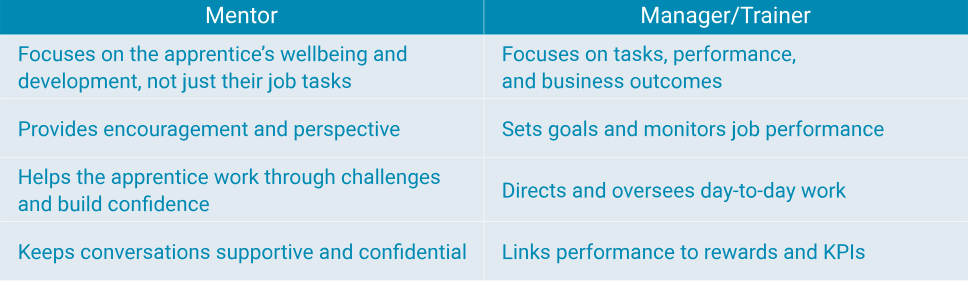
It's important to understand that mentoring is different from managing or training. A mentor focuses on the apprentice's personal growth — offering encouragement, sharing experience, and helping them build confidence. A manager or trainer is focused on tasks, targets, and performance. Both roles are important, but they serve different purposes and work best when clearly understood and separated.
"My mentor always has ideas for how I could approach things differently or get support when I need it."
"My manager helps me too — but they've got a lot on, and I don't want to seem like I'm falling behind."
Mentoring is an essential tool for passing on wisdom, developing talent and strengthening every part of your business. It's not just support for the apprentice — it's an investment in the future capability of your team and industry.
Apprenticeships can be challenging: pressure to perform, a lot to learn, and often a steep adjustment to the world of work. Mentoring helps apprentices navigate all of that. A good mentor is someone they trust — someone who listens, gives perspective and helps them find their own way forward.
A good start can make all the difference. Many apprentices are already part of your team before they start formal training. Onboarding is your chance to help them connect the dots between work and learning.
Hiring an apprentice isn't just about filling a role; it's an investment in the future of your business and your industry. Many employers say training an apprentice brings real satisfaction — passing on your knowledge, shaping someone's career and building a stronger workforce.
According to the International Labour Organization (ILO), while there are some upfront costs, apprenticeships deliver increasing returns over time: most businesses see clear productivity gains by Year 3, and by Year 5 the investment has usually paid for itself. From then on, you've got a fully trained, confident team member who knows your business, fits your culture and adds real value.
Apprenticeships don't just build skills — they build loyalty, capability and pride.

If a concern arises between you and your apprentice — or with Competenz — raise it early. Our complaints process is fair and confidential; your training advisor or regional manager can guide you through it. Follow the processes in the Competenz complaints policy and process.
Competenz offers free support services to help you train with confidence: mentoring guides, progress tracking tools, wellbeing support and regular check-ins with your training advisor.
If your apprentice has trouble logging into eLearning, our Service Hub team is an email or phone call away. Your training advisor can also guide you through using the system.
As an employer you're responsible for meeting legal obligations related to employment, health and safety, privacy and training agreements. Competenz helps by making sure you're aware of these and supporting you through common questions. Your training advisor can point you to the right resources and explain what's typically expected, but for specific legal questions such as employment disputes or contract issues, seek advice from a qualified employment lawyer or trusted HR professional.
As the employer you're responsible for meeting your obligations under the Health and Safety at Work Act 2015, including a safe working environment. Apprentices also have a duty to take reasonable care of their own health and safety and avoid putting others at risk. Competenz provides training modules and checklists to help apprentices learn safe practices, but we don't provide health and safety advice.
You're required to keep training records and protect learner privacy. If unsure what to collect or how to store it, your training advisor can explain best practices for personal information and data privacy.
If your apprentice needs time off or is facing personal challenges, let your training advisor know. They'll help adjust the training plan and keep the learner supported during time away.
New Zealand's workforce includes people from a wide range of cultural backgrounds, each bringing unique strengths, values and ways of working. Creating an inclusive environment helps apprentices settle in, feel supported and succeed. In practice this could mean:
These aren't major shifts — often it's small changes in how we listen, plan and respond. You don't need to know everything about every culture; what matters is being respectful, open-minded and willing to learn. When people feel welcomed and understood, they're more likely to stay engaged, share ideas and take pride in their work.
Pastoral care is about supporting the whole person, not just their learning journey. It includes being aware of anything that might affect an apprentice's ability to train and work effectively — confidence, motivation, health, family responsibilities, or financial pressure.
In New Zealand, pastoral care is a shared responsibility between the employer and Competenz; under the Education and Training Act, we're both committed to helping apprentices feel safe, supported and equipped for success.
As an employer you play a crucial role: regular check-ins, open communication, and building a strong support network. We recommend assigning a workplace buddy or mentor — someone approachable who can guide them through their first few weeks. If an apprentice is struggling, reach out to your training advisor to explore practical solutions — extra study support, regular catch-ups, or connecting them with wellbeing services and study groups.
If an apprentice is showing signs of stress, burnout or other challenges, the employer and training advisor should stay in close contact and work together on solutions. Your training advisor can check in with the learner and connect them to the right support.
Every apprentice learns differently. If your apprentice has a learning difficulty or needs extra support, Competenz can help you adapt the training approach or arrange additional resources.
If you have concerns about your apprentice's progress in their training, such as falling behind on assessments or struggling with learning, your training advisor is here to help and can agree a plan to get things back on track.
If your concerns are employment matters — such as behaviour, attendance, or attitude at work — these should be handled through your usual HR processes or with your HR representative. Not sure where your concern sits? Check in with your training advisor — they'll help clarify.
Your training advisor can support you with goal setting, milestone reviews and giving constructive feedback. They'll also guide you through completing assessments.
Providing great supervision and mentoring is one of the most important parts of supporting an apprentice. It's more than showing them how to do the job — it's about helping them grow confidence, build good habits, and make steady progress toward their qualification.
Your training advisor will work with you to plan structured on-the-job learning and provide practical tips to guide your apprentice day-to-day. They can help you shape feedback and set clear expectations. For more detailed strategies — including the GROW model for coaching conversations and setting SMART tasks — see the mentoring guide.
To start an apprenticeship, a prospective apprentice must:
If you have employees already working in your business who don't hold a formal qualification, they may be able to have their existing skills recognised through an apprenticeship.
Success in an apprenticeship doesn't happen in isolation. It relies on getting the right people aligned — at work and at home — to support the learner's journey. The apprentice, employer and training advisor form a strong triangle of support, each contributing different insights, tools and encouragement into regular reviews of progress. Just as important is the role of whānau (family and close supporters), who help build resilience, motivation, and a sense of belonging. When everyone pulls in the same direction, apprentices are more likely to succeed, grow their skills and thrive in their career.
Your TA helps you and your apprentice stay on track. They:
They're also the go-to for long-term workforce planning — helping identify future skills needs, reskill staff, and build a culture of ongoing learning. Competenz also offers targeted support:
A good trainer brings out the best in people. They:
Your coaching doesn't just build skills — it builds confidence and loyalty.
70% of learning happens on-the-job, which means you play a key role in your apprentice's development.
Your role includes:
Think of yourself as a coach: guiding, encouraging, and helping your apprentice connect the dots between theory and practice.
Team coach and mentor. You provide the workplace, day-to-day guidance, and real learning opportunities.
A motivated learner gaining skills, confidence and experience to become a valuable part of your team.
Your training partner. We design the programme, provide tools and support you both from start to finish.
Together, we're helping your apprentice grow and strengthening your team and industry.
Upskilling is a team effort — You don't have to figure it out alone. Competenz walks alongside you and your apprentice. When everyone plays their part — like a team on the field — great things happen.
This guide is for business owners, managers and team leaders who want to build skills and confidence in their workforce. It will help you:
Together, we’ll turn talent into capability—building a workforce that’s skilled, adaptable and ready for the future.
Support numbers and emails
We make it easy for you to grow the skills in your team through on-the-job training. Whether you're hiring someone new or upskilling a current employee, we’ll help set up a training programme that works for your business.
From day one, we:
Our training advisors are your go-to support throughout the journey—on hand to make training straightforward and valuable for both you and your apprentice.
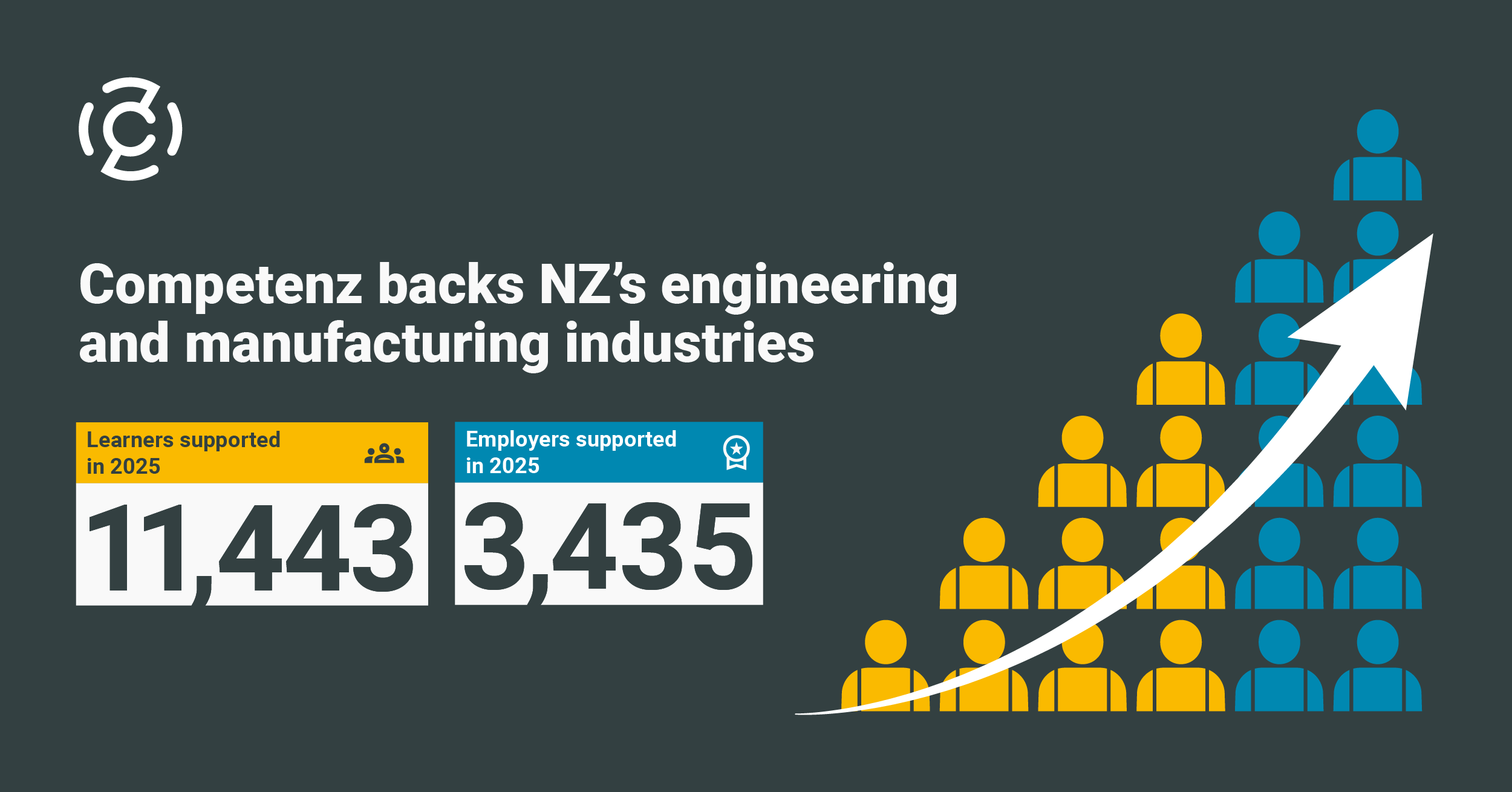
Competenz is one of New Zealand’s leading providers of work-based learning. Each year we support over 12,500 learners and more than 3,500 employers across 30+ industries—from engineering and forestry to fire protection and signmaking.
We work with businesses to build the capability they need to stay productive, competitive and ready for change.
On-the-job training:
More than 60% of apprenticeships begin because an employer sees potential in someone already on their team. When you’ve got the right person, Competenz can help you develop that potential into nationally recognised skills and qualifications.