
Canvas is accessible only within New Zealand and Australia.

Canvas is accessible only within New Zealand and Australia.
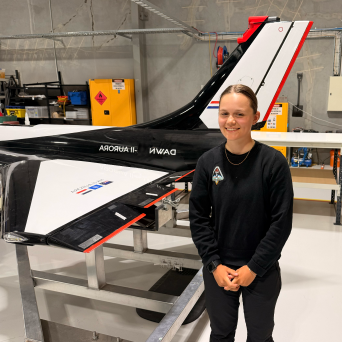
When a spaceplane flew in Christchurch last year carrying experimental hardware developed for California Polytechnic (CalPoly), a young Canterbury engineer was watching closely — knowing components she had helped to manufacture were on board.
Yelena Cunningham, a 21-year-old manufacturing engineer at Dawn Aerospace in Christchurch, played a role in building parts used in the CalPoly spaceplane flight in June last year. The West Melton mechanical engineering apprentice graduate said seeing her work move from a sketch to a flying vehicle was a defining moment.
“I’ve made a few components for the spaceplane which I’ve taken from just being a technical drawing to an actual part,” says Yelena. “We got to watch the spaceplane launch… just seeing and knowing that my parts were on that was just unreal. It was really, really cool.”
Yelena works in the machine shop at Dawn Aerospace in Christchurch, producing high-precision parts that support the manufacture of aerospace hardware used by customers around the world.
She says her pathway into the role has been shaped by hands-on experience — and the confidence to take opportunities as they come.
“I worked part time in two workshops during Year 13. Then I moved halfway through my apprenticeship from the company I was at to Dawn Aerospace because I got this opportunity… and it’s been really cool,” she says. “So Dawn is the fourth workshop I’ve been in, and these different exposures have been valuable to learn from.”
Yelena says Dawn has stood out for the way the team supports learning on the job, including trusting apprentices with learning to operate million-dollar machines.
“They’ve been really good,” she says. “They put me on the top machine in our workshop to allow me to learn on that. And they’ve been really patient.
“All the guys in the workshop are knowledgeable and passing on that knowledge is really cool. They let me do all the programming and the CAD. Their patience is really good. It allows me to learn without pressure.”
Dawn Aerospace Brand and Spaceplane Marketing Lead Annelies Powell says that culture of learning is deliberate — and closely tied to the pace required in a start-up environment.
“A lot of the environment that we want to create is space for innovation,” says Annelies. “Space for innovation requires lots of testing and failing — fly early, fly often and test early, test often — is a mantra we say often.”
Dawn Aerospace employs around 130 people globally, with roughly half based in New Zealand. While the company operates across advanced manufacturing, engineering, design and commercial functions, apprenticeships play a small but important role, with Yelena one of just three apprentices to have come through the business.
Dawn’s work spans two core technology areas.
“In simple terms, we like to say we get things from Earth to space, and from space to everywhere else,” says Annelies.
Dawn’s satellite propulsion technology supports customers putting payloads into orbit — and Yelena’s work is closely connected to that.
“The propulsion systems have thrusters and electronics and tanks, and a bunch of all of that hardware is what Yelena puts her hands on to help get to the manufacturing side of it,” says Annelies.
She says Yelena’s story highlights the value of people finding their passion early — and having strong support around them.
“Some people don’t find what they’re passionate about until they’re like 30 or 40. Yelena has tapped into that young and gone really hard on it. Our people are really agile in their learning environment and move really quickly — and that’s important for Dawn as a company.”
Yelena recently completed her New Zealand Certificate in Mechanical Engineering (Level 4) with a strand in Machining through industry training organisation Competenz. She says her Training Advisor, John Nortman, played an important role in supporting her through the apprenticeship, particularly when she made the decision to change employers part-way through.
“John was helpful,” says Yelena. “He was also supportive when I made the tough decision to move companies halfway through my apprenticeship to Dawn.”
She says he has encouraged her to keep building on her qualification.
“He encouraged me to continue my studies further, towards Level 5 or 6 mechanical engineering,” she says.
Says John, “Yelena is reliable and an excellent communicator; she’s also highly motivated to do well. When she was considering a move to Dawn Aerospace, I gave her clarity around what would happen when she moved from one company to another, relative to the apprenticeship contract and time frames of when her learning would restart, so she could plan her training and progression.
“It was Yelena who had initiated the move to gain more multi-axis programming and machining time on more complex machinery. I just reinforced that she was advancing her career, and it would be a great learning curve to enable and grow her skill set.”
While engineering remains underrepresented for women, Yelena says being the only female in the workshop hasn’t been a barrier.
“I get asked quite a lot if I find it strange that I’m the only female in the workshop, and I really don’t,” she says. “I don’t even notice it half the time, to be honest.
“All the guys are really supportive and just treat me like one of their own. They’re really respectful and I’ve never really had any problems — even at the places before Dawn.”
Yelena hopes more young women — particularly those who enjoy problem-solving and practical work — take a closer look at manufacturing and mechanical engineering.
“I wouldn’t say I was fantastic at school. I was pretty average,” she says. “For me, it’s about seeing how to do the physical things and then doing it yourself. That’s how I learn and why I can recommend mechanical engineering to other females who learn in the same way.
“Engineering can be harder for students to picture, because it’s not something you see every day like in the building and construction trades. A lot of people don’t realise manufacturing exists because they don’t have an opportunity to see it.”
And while she’s creating out-of-this-world products, Yelena is down-to-earth about what comes next.
“I’d like to grow in this job and get into a team lead or management role eventually.”

February 11, 2026

When a spaceplane flew in Christchurch last year carrying experimental hardware developed for California Polytechnic (CalPoly), a young Canterbury engineer was watching closely — knowing components she had helped to manufacture were on board.
Yelena Cunningham, a 21-year-old manufacturing engineer at Dawn Aerospace in Christchurch, played a role in building parts used in the CalPoly spaceplane flight in June last year. The West Melton mechanical engineering apprentice graduate said seeing her work move from a sketch to a flying vehicle was a defining moment.
“I’ve made a few components for the spaceplane which I’ve taken from just being a technical drawing to an actual part,” says Yelena. “We got to watch the spaceplane launch… just seeing and knowing that my parts were on that was just unreal. It was really, really cool.”
Yelena works in the machine shop at Dawn Aerospace in Christchurch, producing high-precision parts that support the manufacture of aerospace hardware used by customers around the world.
She says her pathway into the role has been shaped by hands-on experience — and the confidence to take opportunities as they come.
“I worked part time in two workshops during Year 13. Then I moved halfway through my apprenticeship from the company I was at to Dawn Aerospace because I got this opportunity… and it’s been really cool,” she says. “So Dawn is the fourth workshop I’ve been in, and these different exposures have been valuable to learn from.”
Yelena says Dawn has stood out for the way the team supports learning on the job, including trusting apprentices with learning to operate million-dollar machines.
“They’ve been really good,” she says. “They put me on the top machine in our workshop to allow me to learn on that. And they’ve been really patient.
“All the guys in the workshop are knowledgeable and passing on that knowledge is really cool. They let me do all the programming and the CAD. Their patience is really good. It allows me to learn without pressure.”
Dawn Aerospace Brand and Spaceplane Marketing Lead Annelies Powell says that culture of learning is deliberate — and closely tied to the pace required in a start-up environment.
“A lot of the environment that we want to create is space for innovation,” says Annelies. “Space for innovation requires lots of testing and failing — fly early, fly often and test early, test often — is a mantra we say often.”
Dawn Aerospace employs around 130 people globally, with roughly half based in New Zealand. While the company operates across advanced manufacturing, engineering, design and commercial functions, apprenticeships play a small but important role, with Yelena one of just three apprentices to have come through the business.
Dawn’s work spans two core technology areas.
“In simple terms, we like to say we get things from Earth to space, and from space to everywhere else,” says Annelies.
Dawn’s satellite propulsion technology supports customers putting payloads into orbit — and Yelena’s work is closely connected to that.
“The propulsion systems have thrusters and electronics and tanks, and a bunch of all of that hardware is what Yelena puts her hands on to help get to the manufacturing side of it,” says Annelies.
She says Yelena’s story highlights the value of people finding their passion early — and having strong support around them.
“Some people don’t find what they’re passionate about until they’re like 30 or 40. Yelena has tapped into that young and gone really hard on it. Our people are really agile in their learning environment and move really quickly — and that’s important for Dawn as a company.”
Yelena recently completed her New Zealand Certificate in Mechanical Engineering (Level 4) with a strand in Machining through industry training organisation Competenz. She says her Training Advisor, John Nortman, played an important role in supporting her through the apprenticeship, particularly when she made the decision to change employers part-way through.
“John was helpful,” says Yelena. “He was also supportive when I made the tough decision to move companies halfway through my apprenticeship to Dawn.”
She says he has encouraged her to keep building on her qualification.
“He encouraged me to continue my studies further, towards Level 5 or 6 mechanical engineering,” she says.
Says John, “Yelena is reliable and an excellent communicator; she’s also highly motivated to do well. When she was considering a move to Dawn Aerospace, I gave her clarity around what would happen when she moved from one company to another, relative to the apprenticeship contract and time frames of when her learning would restart, so she could plan her training and progression.
“It was Yelena who had initiated the move to gain more multi-axis programming and machining time on more complex machinery. I just reinforced that she was advancing her career, and it would be a great learning curve to enable and grow her skill set.”
While engineering remains underrepresented for women, Yelena says being the only female in the workshop hasn’t been a barrier.
“I get asked quite a lot if I find it strange that I’m the only female in the workshop, and I really don’t,” she says. “I don’t even notice it half the time, to be honest.
“All the guys are really supportive and just treat me like one of their own. They’re really respectful and I’ve never really had any problems — even at the places before Dawn.”
Yelena hopes more young women — particularly those who enjoy problem-solving and practical work — take a closer look at manufacturing and mechanical engineering.
“I wouldn’t say I was fantastic at school. I was pretty average,” she says. “For me, it’s about seeing how to do the physical things and then doing it yourself. That’s how I learn and why I can recommend mechanical engineering to other females who learn in the same way.
“Engineering can be harder for students to picture, because it’s not something you see every day like in the building and construction trades. A lot of people don’t realise manufacturing exists because they don’t have an opportunity to see it.”
And while she’s creating out-of-this-world products, Yelena is down-to-earth about what comes next.
“I’d like to grow in this job and get into a team lead or management role eventually.”


%20(1).png)
%20(2).png)
%20(1).png)
